- “Can Digital Marketing Be Replaced by AI?” Brief explanation of the rise of Artificial Intelligence in marketing meta ads
- Growing use of AI tools in content creation, advertising, and analytics
- Introduce the main question: Can AI fully replace digital marketing professionals?
- Thesis statement: AI is transforming digital marketing significantly, but human creativity, strategy, and emotional understanding still play a major role. “Can Digital Marketing Be Replaced by AI?”
2. What Is AI in Digital Marketing? (120–150 words)“Can Digital Marketing Be Replaced by AI?”
- Define AI in simple terms
- Explain how AI is used in digital marketing today
- Mention common AI-powered tools and technologies:
- Chatbots
- Content generators
- Predictive analytics
- Automated email marketing
- AI ad optimization
- Brief examples of companies using AI successfully
3. Areas Where AI Is Replacing Traditional Marketing Tasks (150–180 words)
Content Automation
- AI-generated blog posts, captions, and product descriptions
- Faster content production
Advertising Automation
- AI-based ad targeting and bidding
- Personalized ads using user behavior data
Customer Support
- Chatbots handling customer queries 24/7
Data Analysis
- AI processing large amounts of customer data quickly
- Better audience insights and trend prediction
4. Advantages of Using AI in Digital Marketing (120–150 words)“Can Digital Marketing Be Replaced by AI?”
- Increased efficiency and speed
- Cost reduction for repetitive tasks
- Improved personalization
- Better decision-making using real-time data
- Ability to run campaigns continuously with minimal manual effort
5. Limitations of AI in Digital Marketing (150–180 words)
Lack of Human Creativity
- AI can generate content but may struggle with originality and storytelling
Emotional Understanding
- Difficulty understanding human emotions, humor, and cultural context
Dependence on Data
- AI performance depends heavily on data quality
Ethical and Privacy Concerns
- Data collection and personalization issues
- Risk of misinformation or low-quality automated content
6. Why Human Marketers Are Still Important (120–150 words)
- Strategic thinking and brand vision
- Creative campaign development
- Relationship building with customers
- Crisis management and ethical decision-making
- Human ability to understand trends beyond data
7. The Future of AI and Digital Marketing (100–120 words)
- AI will continue to automate routine marketing tasks
- Marketers may shift toward strategy and creativity-focused roles
- Collaboration between AI tools and human marketers will likely become the standard
- Importance of learning AI skills for future marketers
8. Conclusion (80–100 words)“Can Digital Marketing Be Replaced by AI?”
- Summarize the impact of AI on digital marketing
- Reaffirm that AI is a powerful tool rather than a complete replacement
- Final thought: The future of digital marketing is likely to involve humans and AI working together rather than AI taking over entirely.
Areas Where AI Is Replacing Traditional Marketing Tasks
AI is replacing many common marketing tasks today. Businesses use AI tools to save time and improve their work. These tools can handle many tasks that people once did manually.
One major area is content creation. AI tools can write blog posts, social media captions, product descriptions, and emails in just a few seconds. This helps businesses create content faster and post more often online.
AI is also changing online advertising. Many advertising platforms now use AI to study customer behavior and interests. AI can choose the best audience for ads and improve ad performance automatically. It can also adjust ad budgets to get better results.
Customer support is another area where AI is growing fast. Many businesses use chatbots to answer customer questions day and night. These chatbots can solve simple problems and reply quickly without human help.
AI also helps with data analysis. Digital marketing creates a large amount of customer data every day. AI tools can study this data quickly and find useful information. Businesses use these insights to understand customers better and improve marketing campaigns.
Advantages of Using AI in Digital Marketing
AI offers many benefits in digital marketing. One big advantage is speed. AI can complete tasks much faster than humans. It can create content, study data, and manage ads in a short time.
AI also helps businesses save money. Companies can automate repetitive tasks instead of hiring large teams for every job. This helps small businesses improve marketing without spending too much.
Another advantage is personalization. AI studies customer behavior and interests. Then it shows people content and ads that match their needs. Personalized marketing often brings better results and more customer engagement.
AI also improves decision-making. It gives businesses real-time data and reports. Marketers can quickly see what works and what does not. This helps them improve campaigns faster.
Finally, AI tools can work 24/7 without breaks. Businesses can run ads, answer customer questions, and track performance all day and night. This makes digital marketing more efficient and productive. Bloghttps://en.wikipedia.org/wiki/History_of_Wikipedia. 
Limitations of AI in Digital Marketing
Even though AI is very useful, it still has many limitations. AI can help marketers, but it cannot fully replace human thinking and creativity.
One major problem is creativity. AI can create content quickly, but the content may sound repetitive or boring. It often struggles to create fresh ideas, emotional stories, or unique marketing campaigns. Human marketers understand emotions and trends better than machines.
AI also has trouble understanding human feelings. It cannot fully understand humor, emotions, or cultural differences. Sometimes AI-generated content may sound unnatural or insensitive. This can create problems for brands and businesses.
Another limitation is data dependence. AI works best when it has large amounts of accurate data. If the data is poor or incorrect, AI can make bad decisions and produce weak results.
There are also privacy and ethical concerns. Many AI tools collect customer data to improve marketing. Some people worry about how companies use this data. AI can also spread false or low-quality information if businesses use it carelessly.
Because of these limitations, businesses still need human marketers to guide and improve AI-powered marketing strategies. 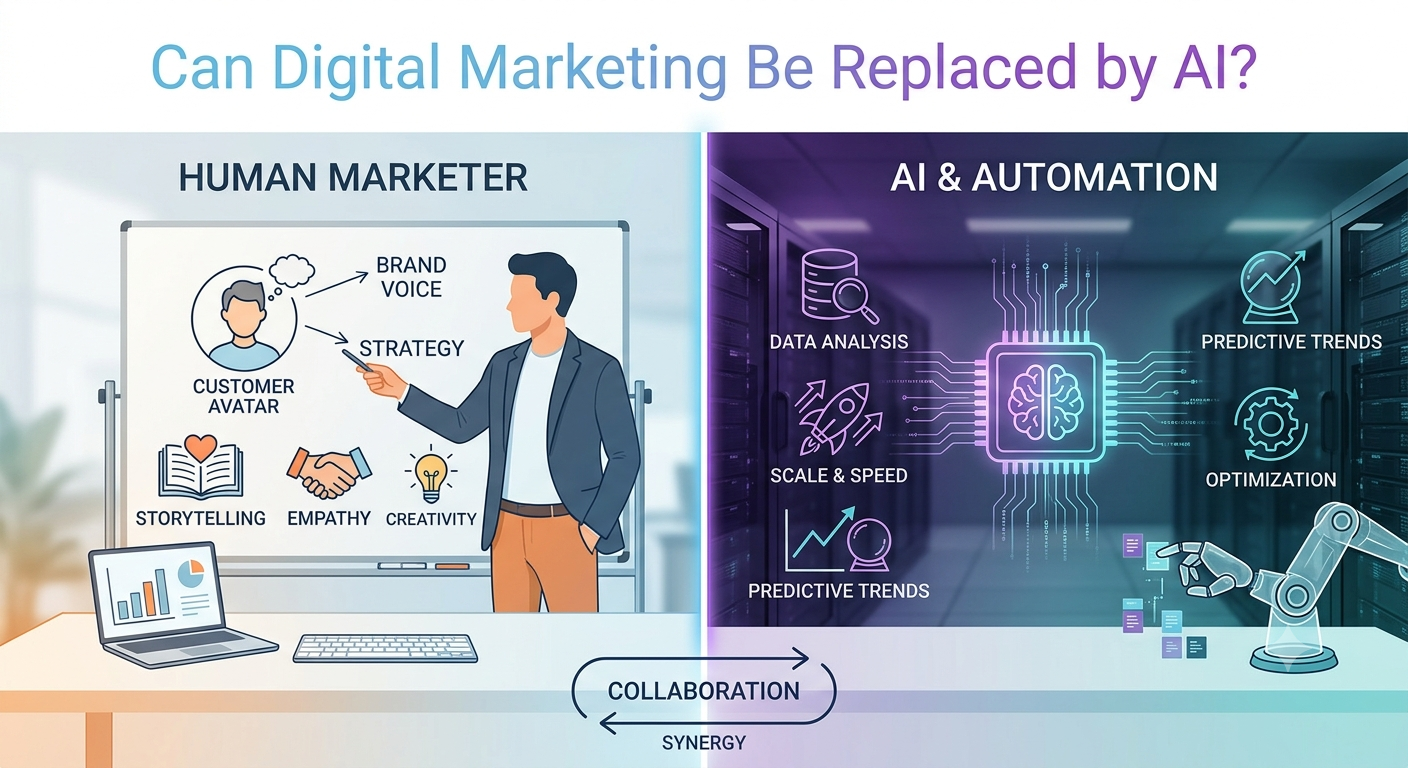
Why Human Marketers Are Still Important
Human marketers still play a very important role in digital marketing. AI can automate tasks, but it cannot fully replace human skills and ideas.
Marketing needs creativity and original thinking. Human marketers create unique campaigns that connect with people emotionally. They understand stories, humor, and emotions in ways that AI cannot.
People also make better strategic decisions. Marketers study market trends, customer needs, and business goals before creating campaigns. AI can provide data, but humans decide how to use that information wisely.
Human connection is another important factor. Customers often trust brands that feel personal and authentic. Human marketers build relationships with customers through communication and understanding.
Marketers also handle difficult situations better than AI. During a crisis or public issue, businesses need human judgment and careful communication. AI may not understand the situation correctly.
For these reasons, AI works best as a support tool. Human marketers still guide the creative and strategic side of digital marketing.
The Future of AI and Digital Marketing
AI will continue to grow in digital marketing in the coming years. More businesses will use AI tools to automate daily marketing tasks. AI will help companies create content faster, improve ads, and study customer behavior more easily.
At the same time, the role of digital marketers may also change. Instead of spending time on repetitive tasks, marketers may focus more on creativity, planning, and customer relationships. Human skills like storytelling, communication, and strategic thinking will remain important.
Many experts believe the future of digital marketing will involve teamwork between humans and AI. AI can handle data and automation, while humans can manage creativity and decision-making. This combination can help businesses achieve better results.
Because of this shift, marketers should learn how to use AI tools effectively. Understanding AI can help them stay competitive and improve their skills in the future job market.
Conclusion
AI is changing digital marketing in many ways. It helps businesses save time, reduce costs, and improve marketing performance. AI can create content, run ads, analyze data, and provide customer support more efficiently than before.
However, AI still has important limitations. It cannot fully replace human creativity, emotions, and strategic thinking. Digital marketing needs human understanding to build strong customer relationships and create meaningful campaigns.
For this reason, AI is best seen as a helpful tool rather than a complete replacement for digital marketers. In the future, businesses will likely use both AI technology and human skills together to achieve the best marketing results .

good good very good article.