What Is Conversion Rate Optimization (CRO)? Getting visitors to your website is important, but traffic alone does not grow a business. You also want visitors to take action. They may buy a product, fill out a form, book a call, or sign up for an email. HOME
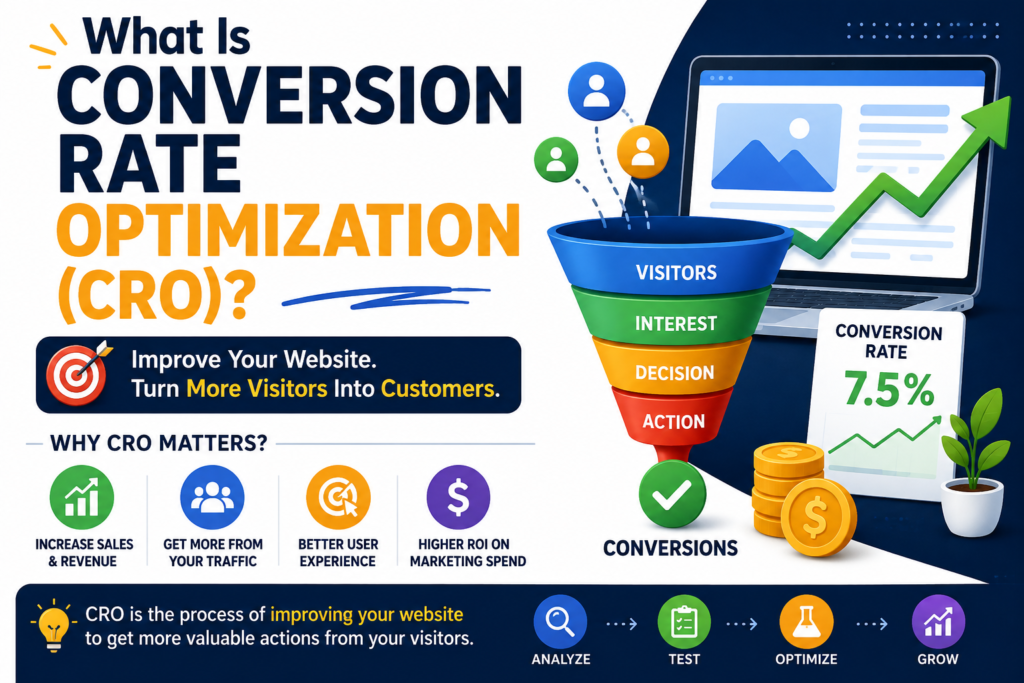
Conversion Rate Optimization, or CRO, is the process of improving a website so more visitors complete the action you want. It is a continuous process because customer needs and website behavior can change over time. That is why regular testing can keep your pages useful and effective for your audience.
What Is a Conversion?
A conversion happens when a visitor completes an important action on your website.
The action depends on your business. For example:
- Buying a product
- Filling out a contact form
- Calling your business
- Booking an appointment
- Signing up for a newsletter
- Downloading a guide
What Is Conversion Rate?
The conversion rate tells you how many visitors completed your chosen action.
For example, imagine 1,000 people visit your website and 50 of them buy something. Your conversion rate is 5%.
Why Is CRO Important?
You may already be spending money on SEO, social media, or online ads to bring people to your website. If visitors arrive but do nothing, part of that effort is being wasted.
CRO focuses on improving the experience after people reach your website.
For example, changing a confusing form, improving a product page, or making a button easier to notice may encourage more people to take action.
How Does CRO Work? 
CRO starts with understanding visitor behavior. You need to find out where people are facing problems.
You can study website data, check which pages receive the most visits, and see where visitors leave. You can also ask customers what they found confusing.
After finding a problem, you can test a possible improvement.
For example, suppose many people visit your service page but very few contact you. You could test a clearer headline, a shorter form, stronger proof, or a more visible contact button.
Important Areas for CRO
There are several parts of a website that can affect conversions.
1. Headlines
Your headline should quickly tell visitors what you offer and why it may help them. https://en.wikipedia.org/wiki/Main_Page
2. Call-to-Action Buttons
A CTA tells people what to do next. Words such as “Get Started,” “Request a Quote,” or “Buy Now” can make the next step clear.
3. Website Speed
People may leave if a page takes too long to load. A faster website creates a smoother experience.
4. Mobile Experience
Many visitors use phones. Your pages, forms, buttons, and images should work properly on small screens.
5. Trust
Visitors may hesitate when they do not trust a website. Reviews, customer stories, clear contact details, secure payment options, and useful information can reduce doubts.
6. Forms
Long or confusing forms can stop people from submitting their details. Ask only for information you really need.
Common CRO Mistakes
One common mistake is changing many things at once. If you change the headline, button, images, form, and offer together, you may not know which change affected the result.
Another mistake is making decisions based on guesses. Website data and customer feedback can give you better ideas.
You should also avoid copying what another business does. What works for one website may not work for another.
What Is Conversion Rate Optimization (CRO)? Final Thoughts
Conversion Rate Optimization is about helping more website visitors take useful actions. It is not simply about changing button colors or adding more sales messages.
Good CRO starts with understanding visitors, finding problems, testing improvements, and measuring the results.
You do not need to change your entire website at once. Start with one important page and one clear problem.
Keep learning from your visitors and improve your website step by step. Over time, these improvements can help you generate more leads, sales, and business from the traffic you already receive.
?)