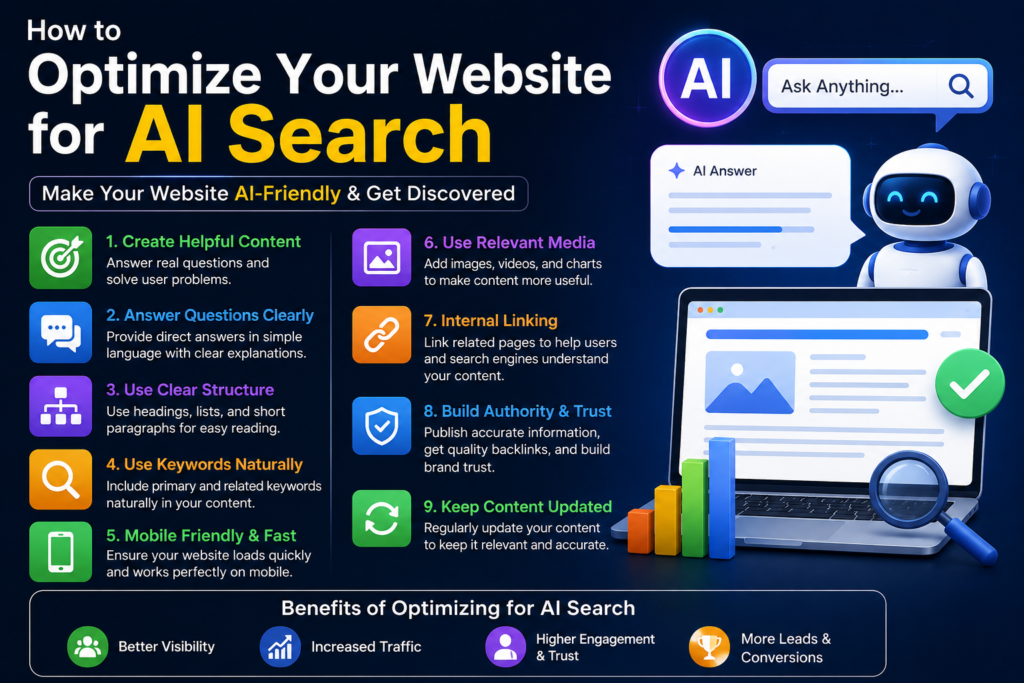
How to Optimize Your Website for AI Search The way people find information online is changing. Many people now ask AI tools complete questions instead of searching with only two or three words.
For website owners, this means there is a new way to think about online visibility. Your website needs more than keywords. It needs information that is clear, useful, and easy to understand.
Here are some practical ways to prepare your website for AI-based search.
1. Start With Your Audience
How to Optimize Your Website for AI Search What are they trying to learn? What problems are they facing? What kind of help are they looking for?
For example, a digital marketing website can answer questions about getting leads, improving websites, running ads, building social media pages, and increasing online sales.
When you understand your audience, it becomes much easier to choose useful topics.How to Optimize Your Website for AI Search
2. Turn Common Questions Into Articles
Your customers already have questions. Use those questions as ideas for your content.
For example, a business owner may ask:
How can I get more customers from Google? meta ads
Instead of writing a general article about Google, create a guide that explains different ways a small business can attract customers through search.
This gives your article a clear purpose and makes it more useful to the person reading it.
3. Explain Things Step by Step
People understand information faster when it is presented in a logical order.
If you are teaching a process, show the steps from beginning to end.
For example, an article about running an online ad could explain:
- Choose the goal.
- Decide who should see the ad.
- Prepare the advertisement.
- Set the budget.
- Start the campaign.
- Check the results.
This approach makes complicated subjects easier for beginners.
4. Use Your Own Examples
Generic information is available everywhere.
Your article can become more valuable when you explain something using your own examples.
Suppose you are writing about SEO. Instead of only explaining what keywords are, show how you would choose a keyword for a real business.
You can also talk about common mistakes, lessons from your work, or simple situations that beginners can understand.
Real examples give your content a more personal feel.
5. Keep Your Sentences Short
You do not need complicated English to explain a marketing topic.
Use short sentences whenever possible.
Instead of writing several ideas in one long sentence, separate them into smaller sentences.
This makes your article easier to read on both computers and phones.
It also helps readers understand your main point without reading the same sentence twice.
6. Give Each Page One Main Purpose
Do not try to answer ten unrelated questions on one page.
If you are writing about Meta Ads, keep the article focused on Meta Ads.
If another topic is about local SEO, create a separate article for it.
You can then connect the two pages with internal links when they are related.
This creates a cleaner website and helps visitors find information about the topics they care about.
7. Make Your Website Simple 
Good content will not help much if your website is difficult to use.
Keep your menu simple. Make important pages easy to find. Check that your buttons and links work.
Your website should also display properly on mobile phones.
Open your own website on your phone and check it like a normal visitor. If something feels difficult or confusing, improve it. https://en.wikipedia.org/wiki/Khan_Academy
8. Use Images for a Reason
Images can make an article easier to understand.
For a tutorial, you can use screenshots. For a process, you can use a simple diagram. For data, you can use a chart.
The image should support the information on the page.
Avoid adding unrelated pictures just because the article needs an image.
9. Do Not Force Keywords
Keywords can help search systems understand your topic, but repeating the same phrase too often can make your writing sound unnatural.
Use your main phrase where it fits.
Then explain the subject normally using related words.
For example, if your topic is AI search, you can naturally discuss search engines, AI tools, website content, online visibility, and search behavior.
Write for the person reading the page, not for a keyword counter.
10. Improve Older Content
Your website should not only receive new articles. Older articles also need attention.
Look through your previous posts and check the information.
Are the links still working? Are the examples still useful? Have the tools or platforms changed?
Make updates when necessary.
This can keep your website useful even after an article has been online for a long time.
11. Make Your Website Trustworthy
Visitors want to know whether the information they are reading is reliable.
Tell people who runs your website. Add an About page and provide a clear way to contact your business.
When you use statistics or important facts, check the information before publishing it.
Avoid making promises that sound too good to be true.
A website becomes stronger when visitors feel that the information is honest and useful.
How to Optimize Your Website for AI Search Final Thoughts
Preparing a website for AI search is not about finding one secret technique.
It is about doing the basic things well.
Understand your audience. Answer useful questions. Explain topics clearly. Add your own examples. Keep your website simple, fast, and easy to use.
Most importantly, create content because you want to help your readers.
When people find your website useful, they are more likely to read your other pages, return later, and trust your business.
For simple and practical digital marketing tips, visit DM With Karann.
