GEO vs SEO: How Search Is Changing in 2026 
Search is changing quickly in 2026. People are no longer using search engines only to find website links. Many users now ask questions in a natural way and expect direct answers. AI-powered search tools can understand these questions and provide information from different sources.
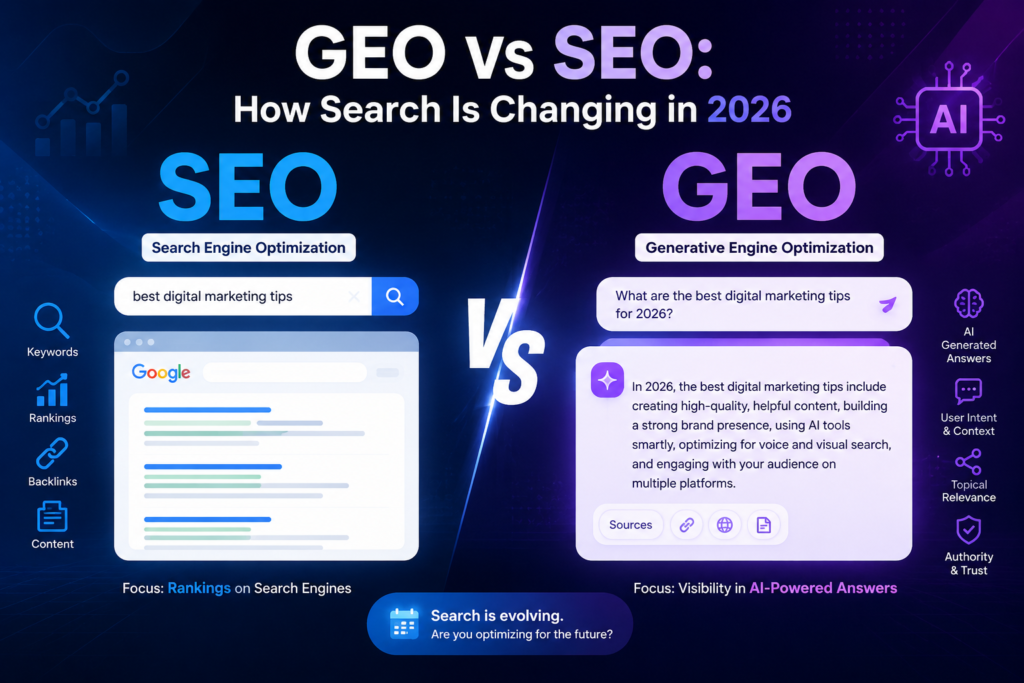
This change has introduced a new term called GEO, or Generative Engine Optimization. At the same time, traditional SEO, or Search Engine Optimization, is still an important part of online marketing.
So, what is the difference between GEO and SEO? Do businesses need both? Let us understand it in simple words.
What Is SEO?
SEO stands for Search Engine Optimization. It is the process of improving a website so it can appear higher in traditional search results.
GEO vs SEO: How Search Is Changing in 2026 For example, if you search for “digital marketing agency,” a search engine may show many websites. SEO helps a website become more useful and relevant for that search.
SEO includes different activities such as:
- Finding useful keywords
- Creating helpful content
- Improving website speed
- Using proper headings
- Building internal links
- Getting relevant backlinks
- Making websites mobile-friendly
- Fixing technical problems
GEO vs SEO: How Search Is Changing in 2026 The main goal of SEO is to help your website get more visibility and organic visitors.
What Is GEO? https://www.informatechtarget.com/blog/geo-vs-seo-a-marketers-guide-to-dual-optimization/
GEO stands for Generative Engine Optimization. It focuses on making content easier for AI-powered search systems to understand and use when creating answers.
For example, a user may ask an AI search tool: meta ads
“What are the best digital marketing strategies for a small business?”
GEO vs SEO: How Search Is Changing in 2026 Instead of showing only a list of websites, the AI system may create a complete answer. It may also mention or link to sources used for that answer.
GEO focuses on creating useful, clear, trustworthy, and well-structured information that AI systems can understand.
GEO is still a developing area, so there is no guaranteed formula for getting your website mentioned by an AI search system.
GEO vs SEO: What Is the Difference?
GEO vs SEO: How Search Is Changing in 2026 The biggest difference is where you want your content to perform.
SEO mainly focuses on traditional search results.
GEO focuses on AI-generated search experiences.
SEO tries to help your website rank for relevant searches. GEO focuses on making your information useful for AI systems that may use different sources to create a response.
However, these two areas are not completely separate.
A website with strong SEO foundations can also have a good starting point for GEO.
Why Is Search Changing?
GEO vs SEO: How Search Is Changing in 2026 People want faster and more useful answers.
Earlier, users often had to open several websites, compare information, and find the answer themselves.
AI-powered search can make this process easier by understanding a question and presenting information in a conversational format.
This does not mean websites are no longer important. AI systems still need reliable information to create useful answers.
This is why businesses should focus on producing high-quality content instead of trying to find shortcuts.
How Can You Prepare Your Content for GEO?
1. Answer Questions Clearly
Think about the questions your audience asks. Give direct answers instead of hiding the important information inside long paragraphs.
For example, if your article is about SEO, answer questions such as “What is SEO?” and “How does SEO work?”
2. Use Simple Language
Write in a natural way. Avoid complicated sentences when a simple explanation is possible.
Your content should be easy for beginners to understand.
3. Add Useful Examples
Examples make information easier to understand.
If you explain search intent, show different search queries and explain what the user is looking for.
Practical examples can make your content more useful than a basic definition.
4. Organize Your Content
Use clear headings, short paragraphs, bullet points, and numbered steps.
A well-organized article makes information easier to find and understand.
5. Add Original Information
Do not simply repeat what other websites have already said.
Add your own examples, research, experience, observations, or useful explanations.
Original information can give readers more value.
6. Keep Your Content Updated
Search technology changes quickly. Information that is useful today may become outdated later.
Review important articles regularly. Update old information when necessary.
Should You Choose GEO or SEO?
You do not have to choose only one.
The better approach is to use both.
Continue following basic SEO practices such as keyword research, technical SEO, internal linking, website speed, and useful content.
At the same time, make your content clear enough to answer questions directly and provide useful information for AI-powered search experiences.
Think of SEO and GEO as two connected parts of modern content marketing.Final Thoughts
Search is becoming more conversational and intelligent in 2026. SEO is still important, but the growth of AI-powered search is changing how people discover information.
GEO focuses on making content useful for AI-generated answers, while SEO focuses mainly on improving visibility in traditional search results.
The best strategy is not to chase every new trend. Focus on creating content that is accurate, helpful, easy to understand, and genuinely useful.
GEO vs SEO: How Search Is Changing in 2026 Build a strong SEO foundation, answer real questions, add original value, and keep your website updated. This can help your content stay useful as search continues to evolve.
